
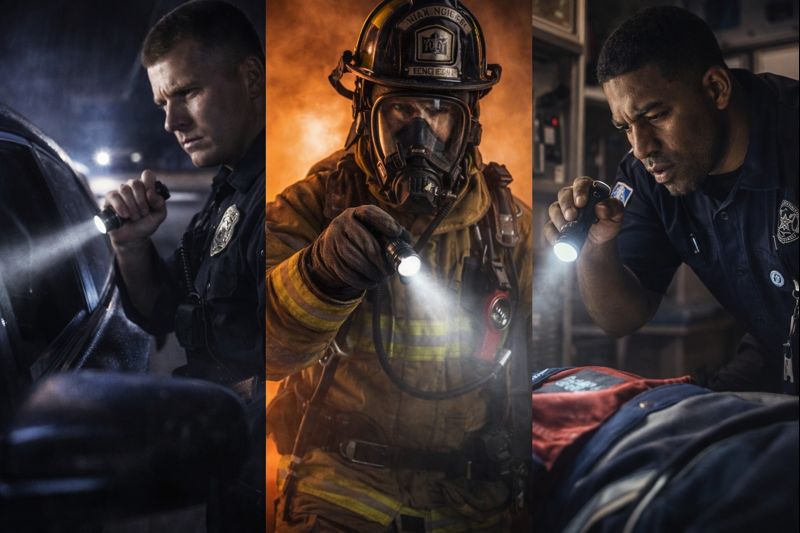
It’s 0230 on a night shift. No moon. Light mist hanging in the air. I’m standing on the shoulder of a back road doing a traffic stop that already feels off. Driver’s hands are moving too much, interior’s blacked out with limo tint, and the nearest streetlight is a hundred yards behind me doing absolutely nothing useful.
This is the moment the internet tells you that if you’re not holding a $200–$300 light from SureFire, Modlite, or Cloud Defensive, you’re basically committing professional malpractice. There’s a stigma in this industry: If it’s cheap, it’s going to get you killed.
And yet, in my hand is a Wurkkos FC12.
Street price? About $30–$40. Less than a tank of gas. Less than a pair of duty gloves. Definitely less than the collective judgment of gear bros who think price equals survivability.
The Specs: Translating Numbers to Street Survival
Let’s strip away the marketing fluff and look at what this thing actually does. The FC12 isn’t chasing the highest lumen number just to look good on a spec sheet; it’s built for throw.
The Emitter: Luminus SFT-40 (a.k.a. “The Puncher”)
The FC12 runs a Luminus SFT-40, which is known as a throw-focused LED. Translation: this light is built to reach out and touch the dark, not just light up your boots.
Many budget lights are “flooders”—they light up a wide area right in front of your feet, which is great for walking the dog but terrible for police work. When I’m searching a backyard or a long alleyway, I don’t need to see my boots; I need to see the fence line 100 yards away. I need to know what is in a suspect’s hands or see that car that’s wrecked off in the woods.
This matters when you’re:
- Scanning long driveways
- Checking tree lines or fields
- Looking into backyards, alleys, or industrial lots
Instead of a wide, floody beam that washes everything evenly, you get a tight, intense hotspot with usable spill around it. That hotspot is what lets you positively identify what (or who) you’re looking at, not just confirm “yep, something’s there.”
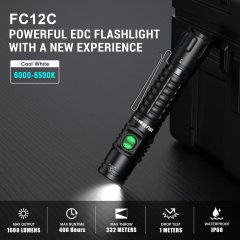
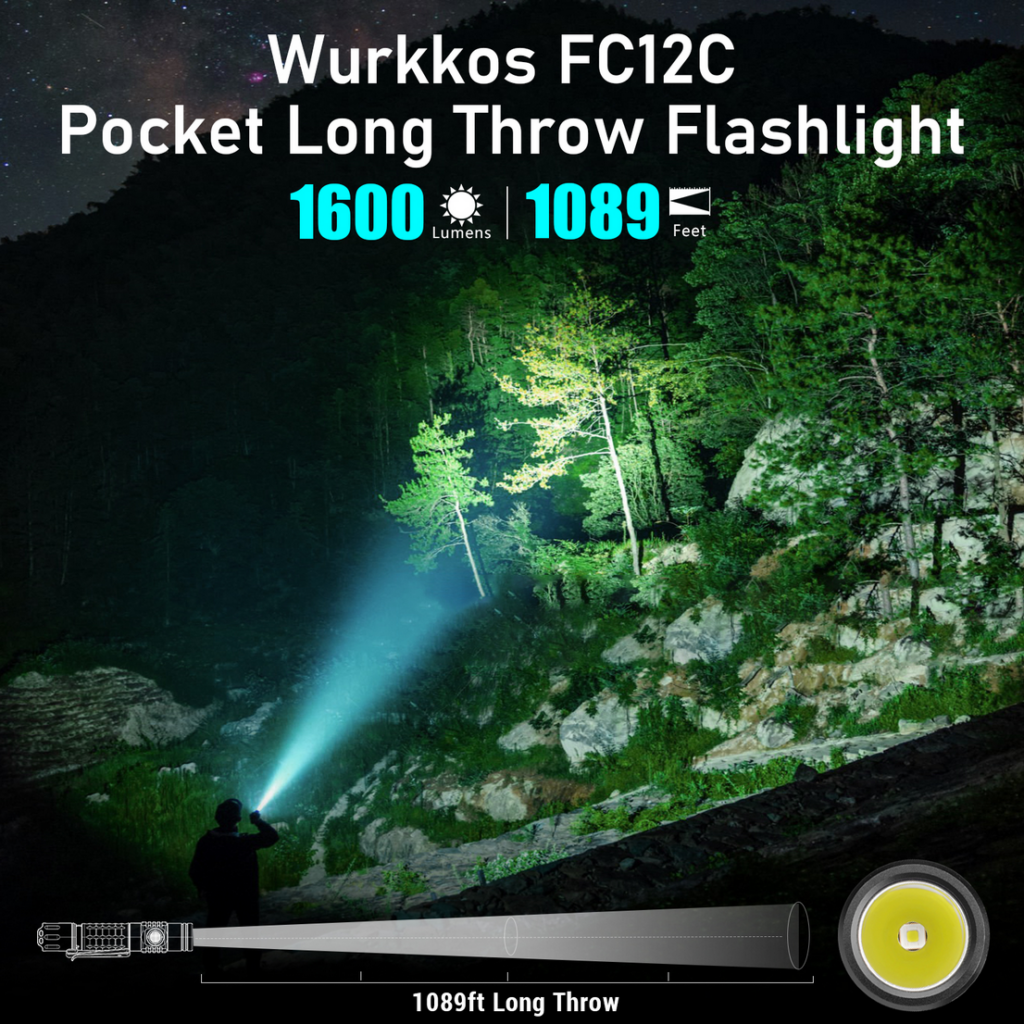
Output: 2,000 Lumens / 345 Meters of Throw
Numbers get abused in flashlight marketing, so here’s the operator translation:
- Lumens = total light output
- Candela / Throw = how far that light stays intense
The FC12’s ~345 meters of throw means it has enough intensity to cut through darkness, fog, and tinted glass without feeling like a useless floodlight past 20 yards.
On paper, this puts it in the same functional category as lights that cost five to seven times more.
The SFT-40 punches a concentrated beam of light deep into the darkness. We’re talking about a claimed 2000 lumens, but more importantly, a tight hotspot that travels up to 345 meters.
The UI: Stress-Proofing Your Light
This is where most budget lights fail the “First Responder Test.” Under stress—when your heart rate is 140bpm and fine motor skills go out the window—you cannot be fumbling with a complex interface.
The FC12 features a dual-switch setup:
- Tail Switch: Controls power (On/Off) and momentary tactical activation.
- Side Switch: Cycles through brightness modes.
Here is the critical part: Out of the box, the light is in a “stepped” mode (Low-Med-High). But the FC12 has a hidden gem called Group 2 (Tactical Mode).
When you switch to Group 2, the light simplifies drastically. The side switch becomes strictly a toggle between Turbo and Strobe. That’s it. No Moonlight mode, no “Eco” setting. When I pull this light out on a traffic stop, I press the tail cap and I know exactly what I’m getting: 100% power, immediately.
The “Duty Test”: Three Months on the Belt
I didn’t baby this thing. I threw it in my sap pocket next to my radio, banged it against door frames, and dropped it more times than I care to admit.
Scenario 1: The Tint Test
Tinted windows are a nightmare for officer safety. You walk up to a sedan with 5% limo tint, and you’re blind. A low-candela light (low intensity) just bounces off the glass.
Because the FC12 is high-candela (high intensity), it punches right through. On a stop last week, I could clearly see the driver reaching for his glove box through a heavily tinted rear window. That kind of visibility buys you reaction time. Reaction time saves lives.
Scenario 2: Durability & The Drop
I was on a perimeter position in the rain a few weeks back. Fumbling with my gloves, I dropped the FC12 onto wet asphalt. It bounced, landed in a puddle, and stayed there for about two minutes while I managed radio traffic.
I picked it up, wiped it off, and it fired right up. It’s rated IPX8 waterproof (submersible up to 2 meters), and the hard-anodized aluminum body has held up against the abrasion of my duty belt. It looks a little scratched up, but tools are meant to be used, not admired.
The Logistics: Power Management
The FC12 runs on a standard 18650 battery. It’s slim, so it doesn’t dig into my ribs when I’m sitting in the squad car like the larger 21700 lights do.
But the real winner here is the USB-C charging port built directly into the neck of the flashlight. This is one of the major reasons that sold me on the FC12 in the first place, is the ability to charge it with the same charging cord I use for my cell phone.
I don’t need to carry a bulky battery charger in my go-bag. If the light dies mid-shift, I plug it into the dash of the cruiser or the ambulance between calls. By the time I reach the next scene, I’ve got enough juice to work.
The Good, The Bad, and The Ugly
I’m not here to sell you a fairytale. No $30 light is perfect. Here is the honest breakdown.
The Good:
- Insane Value: You can buy six of these for the price of one Modlite.
- Throw: The hotspot is crisp and reaches way further than it has any right to.
- Simplicity: Tactical Mode (Group 2) makes it viable for actual police/EMS work.
- Convenience: USB-C charging is a logistics dream.
The Bad:
- Heat: Physics is physics. When you push 2000 lumens through a small aluminum tube, it gets hot. Fast. On Turbo mode, the head of the light gets uncomfortable to touch after about 45 seconds. It has thermal regulation so it won’t melt, but it steps down the brightness automatically to cool off.
- Side Switch vs. Gloves: The side button is metal and flush with the body. If you are wearing thick search gloves in the winter, it can be hard to locate by feel. However, since the tail switch controls the main On/Off, this rarely impacts immediate deployment.
The Ugly:
- The Pocket Clip: It comes with a “two-way” friction clip. It’s… okay. It holds the light securely, but the bottom loop of the clip has a tendency to snag on seatbelts or the hem of my jacket. I eventually took it off and just use a belt pouch.
The Final Verdict
Is the Wurkkos FC12 better than a $300 SureFire? In terms of bomb-proof reliability and American manufacturing? No.
But is it 95% of the performance for 15% of the price? Absolutely.
For the vast majority of us—beat cops, paramedics, security guards, and prepared citizens—the Wurkkos FC12 is more than enough light to get the job done. It identifies threats, cuts through photonic barriers, and survives the daily grind.
My recommendation?
Buy two. One for your belt, one for your car or bag. At a current price of $26.99, its a deal you can’t miss.
You’ll still have money left over for lunch—and more importantly, you’ll have light when you actually need it.
Trackbacks and Pingbacks